Only Hiring: a Reddit job board with the self-promotion and scams filtered out
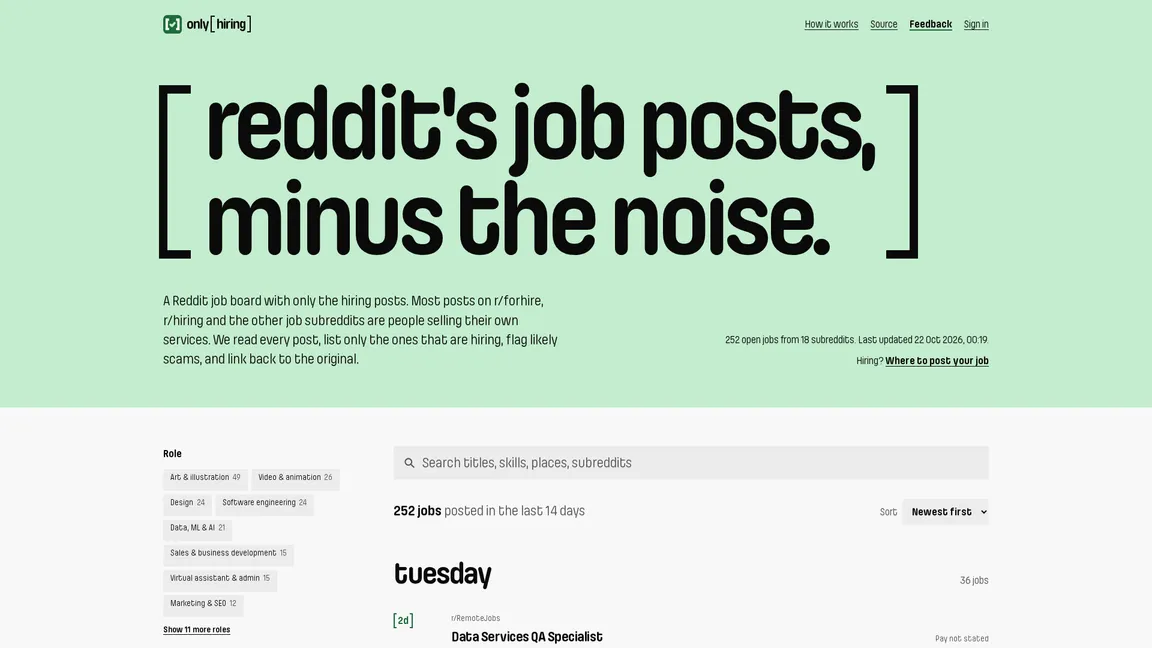
Table of Contents
Reddit's job subreddits are full of small, real jobs, like a logo or a video edit, often from people who would never post on a job board. You have to dig for them, though. Most posts on r/forhire, r/slavelabour and the rest are freelancers advertising their own services or people asking questions, and some of the "jobs" that are left want you on Telegram before they'll tell you anything.
Only Hiring does the digging. It reads every new post from 18 job subreddits, uses an LLM to keep only the ones where someone is paying for work, and puts them on one page with the pay and a scam score for each one. It's free and needs no sign-up, and the website's code is on GitHub under the MIT licence.
Results
- Of the 712 posts the pipeline read by 21 October 2026, 311 (44%) were hiring. The other 401 never reach the board.
- 40 hiring posts got a scam warning that lists its reasons, and 6 were hidden as likely scams.
- Every subreddit has its own page with what it pays and how many of its posts are real jobs, and two guides are built from the same data.
- In the week to 23 October, 839 people visited and viewed 1,587 pages. Reddit sent about 200 of them and Google sent 34.
- In its first six days, Google showed the homepage 270 times in search results, at an average position of 7.6.
Why I built it
I built it for myself. I wanted to find jobs on Reddit and apply to them fast, without wading through the scams and the low-quality posts first.
Skipping the posts tagged [For Hire] doesn't fix that. People tag their own services as [Hiring] to get more views, and plenty of untagged posts are questions about whether Upwork is dead. Even after the tags are filtered out, fewer than half of what's left is a job.
So I wanted one list with only the real jobs that I could read in a couple of minutes, with a warning on the posts that look off. Reddit's search can't do that, because telling a job from an ad means reading the post. Reading thousands of posts and making a judgement call on each one is the kind of work an LLM is good at, as long as you check what it gives back.
What it does
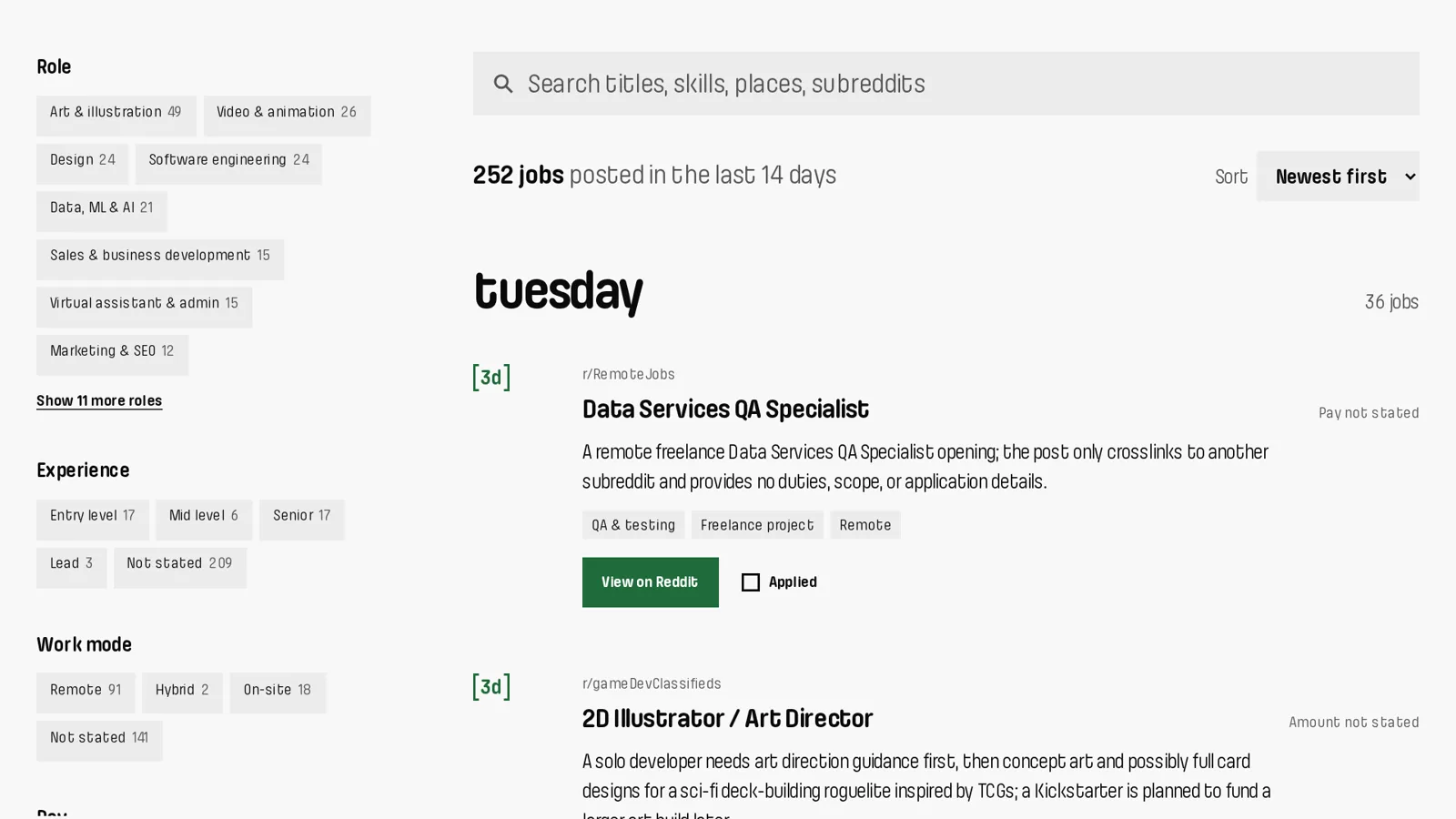
The board is one list of the last 14 days of jobs, newest first and grouped by day. Each job has a short summary, the pay (as written in the post and as numbers), the role, the experience level and whether it's remote. You can filter by any of those, search by skill or place, sort by pay and hide commission-only work with one tick.
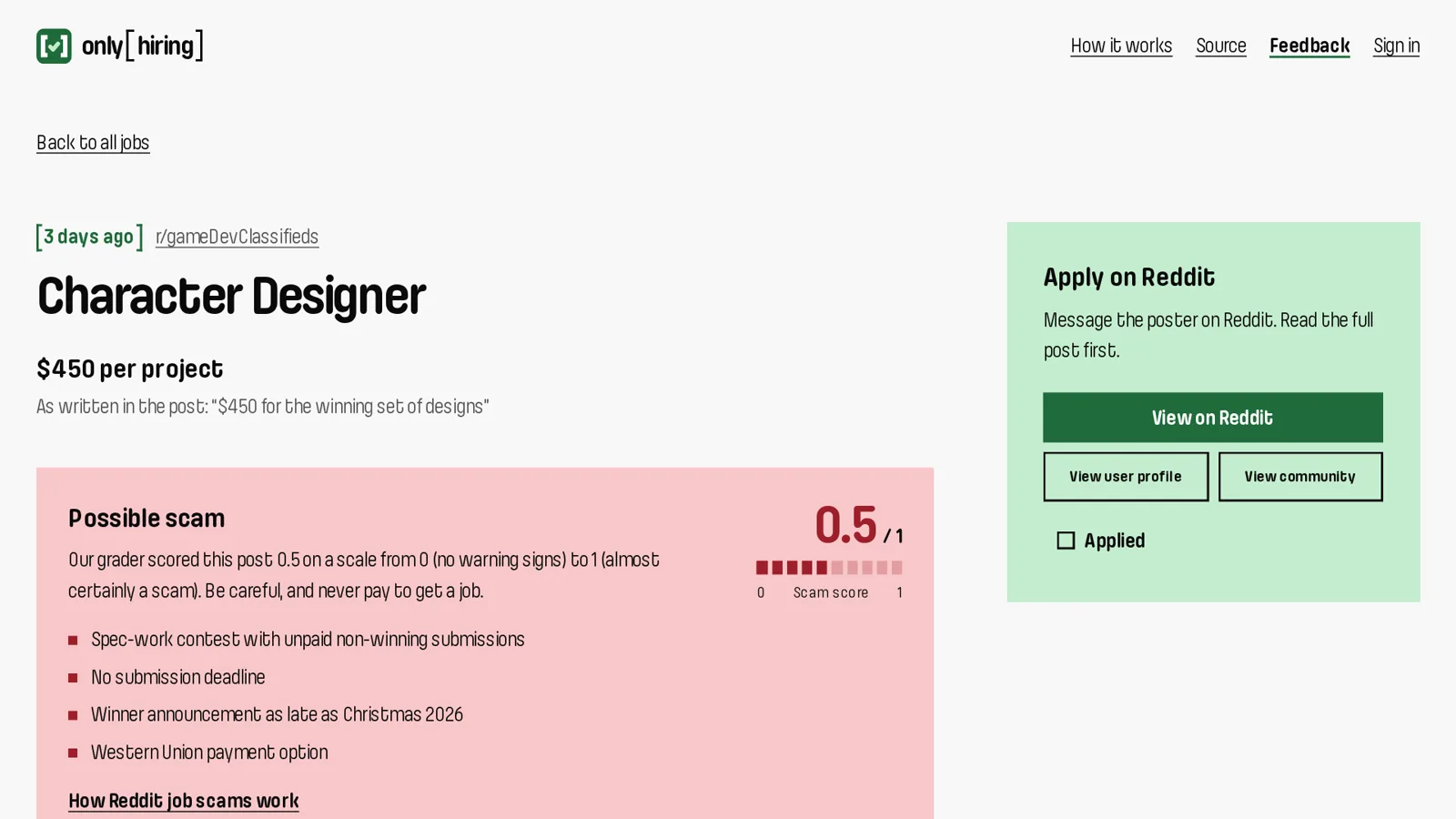
Jobs with a scam score of 0.4 or more get a warning, and the warning lists what the model found suspicious. A score on its own tells you very little, while "spec-work contest with unpaid non-winning submissions" tells you what you'd be signing up for. Posts that score 0.6 or more are hidden unless you choose to see them.
You still apply on Reddit. Every job links to its original post, and the site only stores a summary and the post's opening lines. You can mark the jobs you've applied to and hide them from the list. That works without an account, and signing in keeps the list across devices. There's also an RSS feed of new jobs.
Pages built from the data
The pipeline grades every post, hiring or not, so it also knows how each subreddit behaves. That turned into pages that answer questions people search for:
- a page for each subreddit, like r/forhire, with its open jobs and how much it pays;
- the best subreddits for jobs, ranked by how many hiring posts each one has;
- a section on that guide for people who are hiring, about where to post a job so the right people see it;
- a guide to Reddit job scams, with what the warning signs look like on each subreddit.
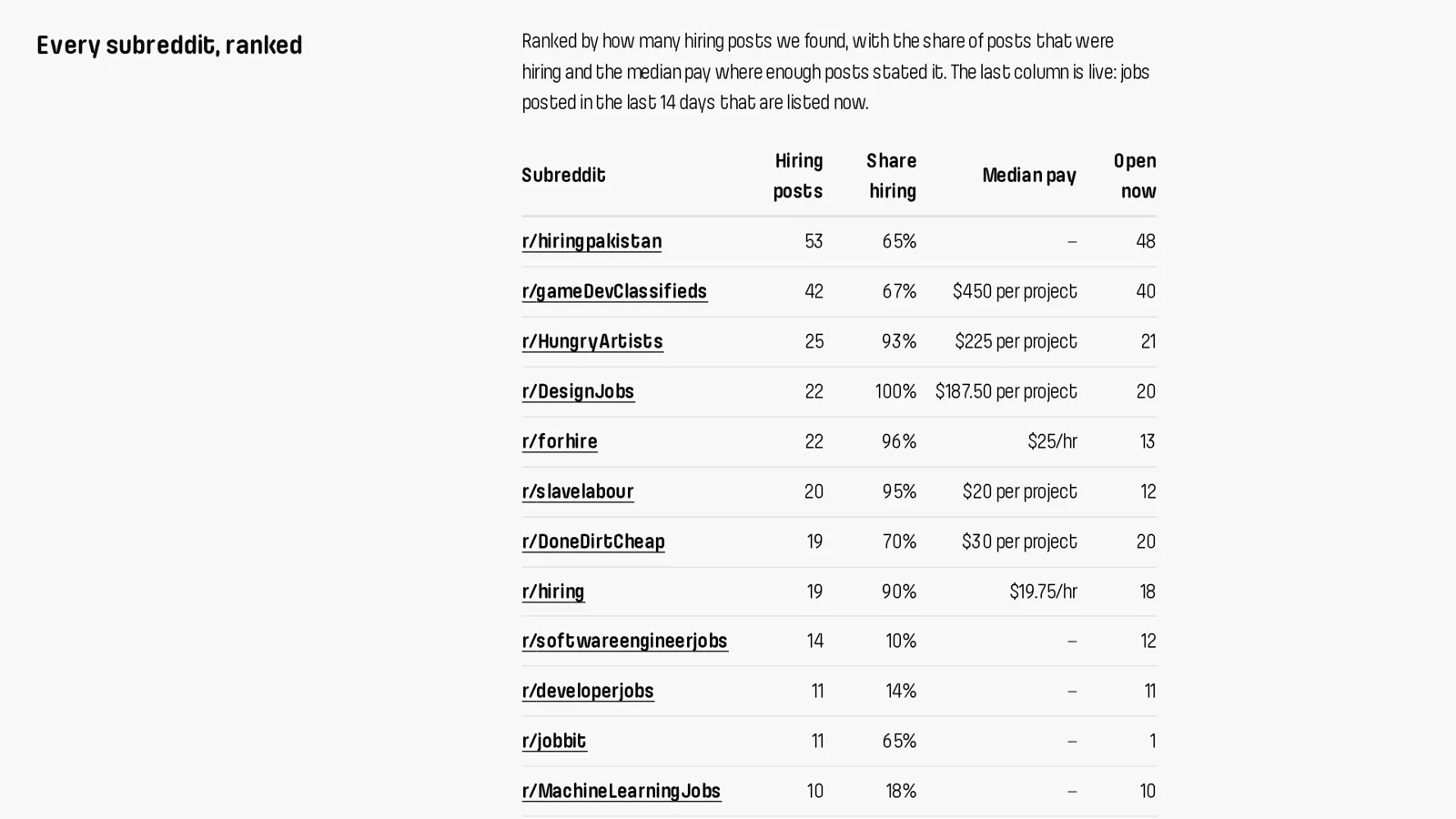
The figures on these pages update every time the pipeline syncs, so I never have to rewrite them by hand.
How it works
There are two parts. A Python pipeline runs on my own machine on a schedule. It pulls new posts and skips anything tagged [For Hire] or [Offer]. The rest go to an LLM (DeepSeek), which decides whether each post is a job and, if it is, pulls out the details and a scam score. Code checks every answer before the jobs go into Postgres. The pipeline also merges reposts and takes down jobs whose Reddit post was deleted.
The website is Next.js on Vercel, and it only ever reads from the database, using a database login that isn't allowed to write. Filtering and search run in the browser, because the list is small enough to send in one go.
I wrote up the LLM side, with the prompt rules that mattered most and the code that cleans up the model's answers, in How I score Reddit job posts for scams with an LLM. It's the same approach I use in client automation work: let the model make the judgement call, then check its output in code before anything relies on it.
What the data shows
The subreddits vary a lot. On r/DesignJobs, every one of the 22 posts the pipeline read was hiring, and r/forhire (22 of 23), r/slavelabour (20 of 21), r/HungryArtists (25 of 27) and r/hiring (19 of 21) were close behind. On r/softwareengineerjobs, only 14 of 147 were, and most of the rest were career questions.
Scams turned out to be rarer than I expected. Of the 311 hiring posts, 40 got a warning and 6 were hidden. Most red flags were about bad terms on real jobs, like very low pay or unpaid test work. I think the list of red flags helps people more than the score does, because it tells them exactly what they'd be agreeing to.
How it looks
I didn't want it to look like another job board template. The site has one shape, the square bracket, taken from the [Hiring] tag people put at the start of their titles. It's in the name, the headline, the age tag next to every job and the filters you select. Mint marks what the site kept and pink marks what it flagged, and everything else is near-white and near-black. The list reads like a menu, with the job title on the left and the pay on the right like a price.
Who's using it
In the week to 23 October, 839 people visited the site and viewed 1,587 pages. About 200 came from links on Reddit, most of them in the Reddit app, and 34 came from Google search. The biggest share of visitors was in Nigeria (38%), followed by the US (19%), Pakistan (7%) and India (5%).
More than half of them were on a phone, so the mobile layout matters as much as the desktop one. On phones, the search bar stays on screen as you scroll, and the filters slide up from the bottom.
What's next
The next step is getting it in front of more people, with launch posts on r/SideProject and Hacker News. I'll add subreddits when readers point me to ones with real jobs (there's a Feedback link on the site for that). Pages for remote jobs and for the busiest roles are also on the list, but only once each has enough jobs to be worth a page of its own.


Dude, you’re at the bottom of my landing page.
Just book a call already if you’re that interested.
You scrolled all the way here.