Writing & Videos — Page 9
Page 9 of 14: older articles, tutorials, and videos.
October 2025
Syncing projects with Google Drive - Part 3 (Upload to Drive)
I implement the upload half of my Drive Syncer by creating Google Drive folders and pushing every local file inside a configured project folder up to Drive. I create the base folder first, query Drive by mimeType, name…
Syncing projects with Google Drive - Part 2 (Config Files and Drive API)
I refactor the Google Drive syncer so the OAuth flow and Drive service setup live in a Drive struct with a Connect method instead of bloating main, then add a JSON config file that drives what gets synced. The config…

Sync code with Google Drive - Part 1 (Google Cloud Console, OAUTH)
I start building a custom Google Drive syncer in Go because GitHub alone did not save me when my hard drive corrupted and I lost local changes that were never pushed. Google Drive’s desktop app can back up whole…
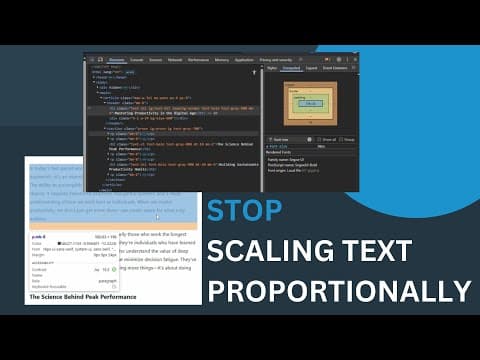
Stop scaling text sizes proportionally
Scaling responsive typography proportionally is a mistake because large headings need to shrink much faster than body text. I demonstrate this on a sample article: the main heading drops from 60px to 30px (50%), the…
Memory Management in Go - Part 2
I break down how Go’s garbage collector works: it’s non-generational, concurrent, and uses a tricolor mark-and-sweep algorithm. I explain why Go skips generational collection — compiler optimizations keep most values…
Memory Management in Go - Part 1
Go runs a garbage collector, but underneath that every variable ends up either on the stack or the heap, and the compiler chooses using escape analysis. I start with why memory management matters at all — C and C++…
Building a Redis clone in Go - Part 20 (Finish INFO & fix AOF memory)
I finish the INFO command by wiring up the persistence and general categories, then fix an AOF bug where restoring the append-only file ignored the server's memory limit. Most of the work is plumbing: tracking RDB…
Building a Redis clone in Go - Part 19 (INFO command)
The INFO command is the last major piece of my Redis clone, and in this part I build out the server, client, and memory sections of its response. I track server start time and peak memory in the app state so uptime…
Building a Redis clone in Go - Part 18 (MONITOR command)
I fix a missing mutex unlock bug in my Go Redis clone, refactor the code into focused files, and then implement the MONITOR command so one client can receive every command other clients run. In DB.Get, I show why every…
Building a Redis clone in Go - Part 17 (allkeys-lru and allkeys-lfu)
I implement Redis's allkeys-lru and allkeys-lfu eviction policies in my Go Redis clone by sorting sampled keys with the metadata already stored on each item, then reusing my evict-until-memory-freed loop. For…
Building a Redis clone in Go - Part 16 (Fixing AOF file sync)
I fix AOF file sync in my Go Redis clone by making every array read share one buffered reader instead of creating a fresh reader each time, which was causing replay to restore only the first key. I also change ReadBulk…


Dude, you’re at the bottom of my landing page.
Just book a call already if you’re that interested.
You scrolled all the way here.